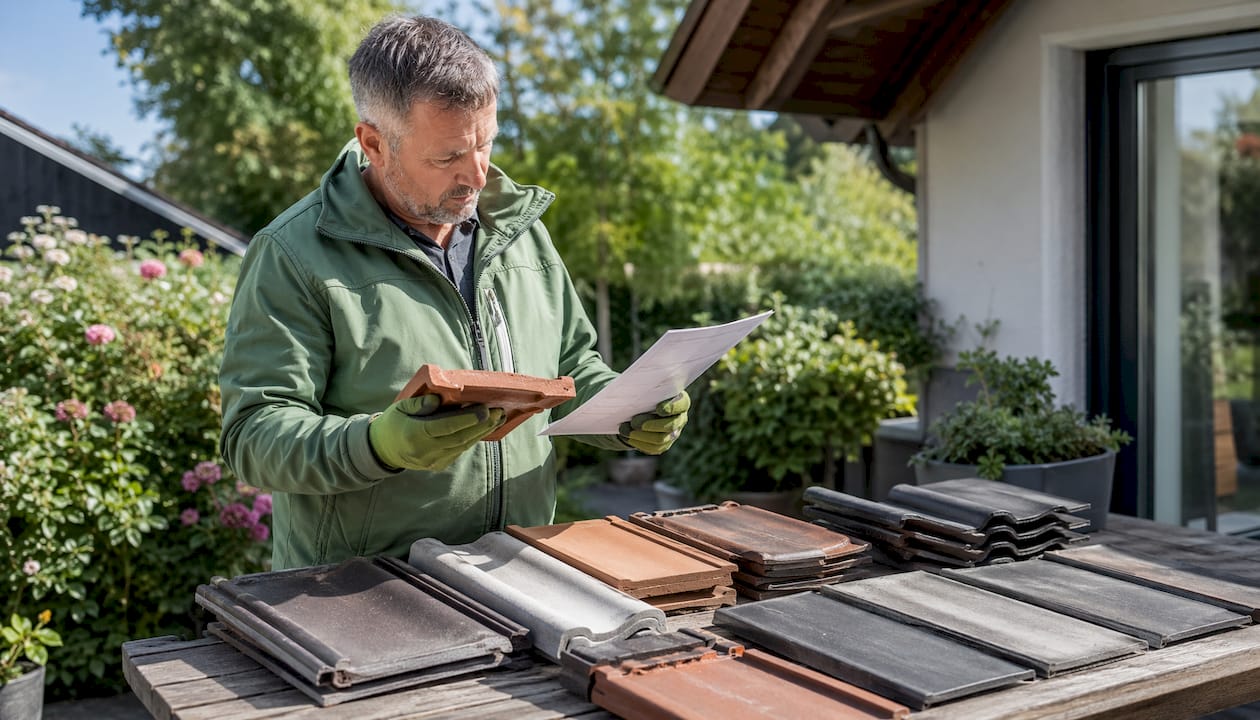
Roof renovation costs vary widely per square metre depending on the scope of work. The range is broad because the term covers everything from simple local repairs to complete refurbishment with new roof structure, insulation and covering. For a typical detached house with an average roof area, reasonable cost ranges can be given for re-roofing, re-roofing with insulation and complete refurbishment.
The key finding first:Commissioning re-roofing and insulation together spreads scaffolding, logistics and setup costs across both measures. The relative additional cost of insulation is then considerably lower than for a separate intervention.
Before requesting quotes, clarify three things immediately:
- Apply for BAFA or KfW funding before awarding a contract. Applying only after awarding the contract means losing the grant.
- Obtain at least three quotes from specialist firms and ensure the work items are comparable.
- Coordinate scaffolding dates early, as roofing firms often have lead times of several weeks in peak season (April to October).
What makes up the price of roof renovation?
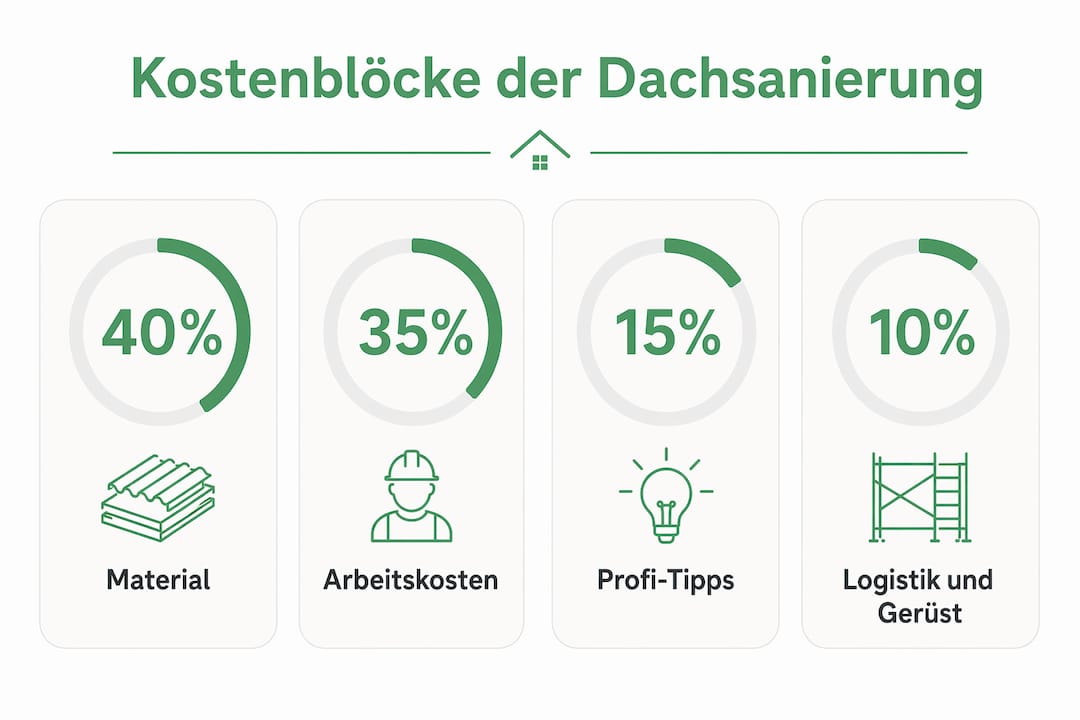
The total price of roof renovation is not a uniform amount, but the result of several cost components with different weightings depending on the project.
| Cost component | Typical share | Particular considerations |
|---|---|---|
| Materials (roof covering, insulation, underlay) | 40 % | Highly dependent on material class and covering type |
| Labour (roofers, carpenters) | 30–40 % | Varies by region and season |
| Scaffolding | 8–15 €/m² of façade area | Fixed cost component shared when measures are combined |
| Disposal (old materials, hazardous waste) | 3–8 % | Higher for asbestos or harmful substances |
| Ancillary costs (structural engineering, design, permissions) | 5–10 % | Mandatory for roof structure work or GEG compliance evidence |
Labour costs vary considerably by region. In southern Germany and urban centres such as Munich or Hamburg, hourly rates for roofing are noticeably above the national average. Seasonality also matters: renovating in spring or summer often costs more than commissioning work in autumn or winter when workloads are lighter.
The master craftsman requirement in roofing is no bureaucratic detail. It secures five years of statutory defects liability for the work. Businesses without approval as a master craftsman firm may not carry out this work, which should be an initial exclusion criterion when reviewing quotes.
Professional tip: Unavoidable costsarise whenever scaffolding and logistics are required anyway. Adding insulation at that point means paying only for its materials plus a small labour surcharge. Commission insulation separately and you pay for the scaffolding in full a second time.
What does roof renovation actually cost? Worked examples for 100, 150 and 200 m²
Four service levels shape the market. The right one depends on your roof's condition, energy efficiency goals and available budget.
- Repair / partial renewal:Replacing individual tiles, sealing valleys, renewing ridge coverings. Suitable for local damage without structural problems.
- Re-roofing only:Complete replacement of the roof covering, including underlay, without insulation work.
- Re-roofing with insulation:Combination of new roof covering and thermal insulation (usually above-rafter or between-rafter insulation).
- Complete refurbishment including roof structure:In addition to covering and insulation, rafters, purlins or the entire roof structure are renewed or strengthened.
| Service level | €/m² (range) | 100 m² example | 150 m² example | 200 m² example | Eligible for funding? |
|---|---|---|---|---|---|
| Repair / partial renewal | 30–80 €/m² | 5.000–8.000 € | 7.000–12.000 € | 10.000–16.000 € | No |
| Re-roofing only | 80–160 €/m² | 8.000–16.000 € | 12.000–24.000 € | — | Conditionally |
| Re-roofing + insulation | 150–300 €/m² | 15.000–30.000 € | 22.500–45.000 € | 30.000–60.000 € | Yes (BAFA/KfW) |
| Complete refurbishment including roof structure | 250–500 €/m² | 25.000–50.000 € | — | 50.000–100.000 € | Partly |
Assumptions behind these figures:The examples assume a simple pitched roof with a moderate slope (30–45°), mid-range concrete or clay tiles, scaffolding costs of around 10 €/m² of façade area and disposal of old materials without hazardous waste. More complex roof forms, premium coverings or contamination noticeably increase costs.
How much do material and roof shape affect the price?
Choosing the roof covering material is one of the most important pricing decisions. And it is not merely a question of taste.
- Concrete roof tiles:15–30 €/m² material cost, cheapest option, lifespan 30–50 years, low maintenance
- Clay roof tiles:40–80 €/m² materials, longer-lasting (50–80 years), better appearance, greater weight may require structural checks
- Slate:90–140 €/m² materials, very long-lasting (80–100+ years), substantial installation effort, frequently required for listed buildings
- Metal roofing (standing seam, trapezoidal sheet):60–120 €/m² materials, lightweight, suitable for shallow slopes, modern appearance
- Flat roof waterproofing (bitumen, EPDM, PVC):40–100 €/m² depending on system, service life 20–40 years, regular maintenance required
| Material | Lifespan | Total cost including installation (guide) |
|---|---|---|
| Concrete roof tiles | standard lifespan | comparatively low total cost |
| Clay roof tiles | relatively long-lasting | mid-range total cost |
| Slate | very long-lasting | higher total cost |
| Metal roof | medium lifespan | medium to higher total cost |
| Flat roof waterproofing | shorter lifespan | lower total cost |
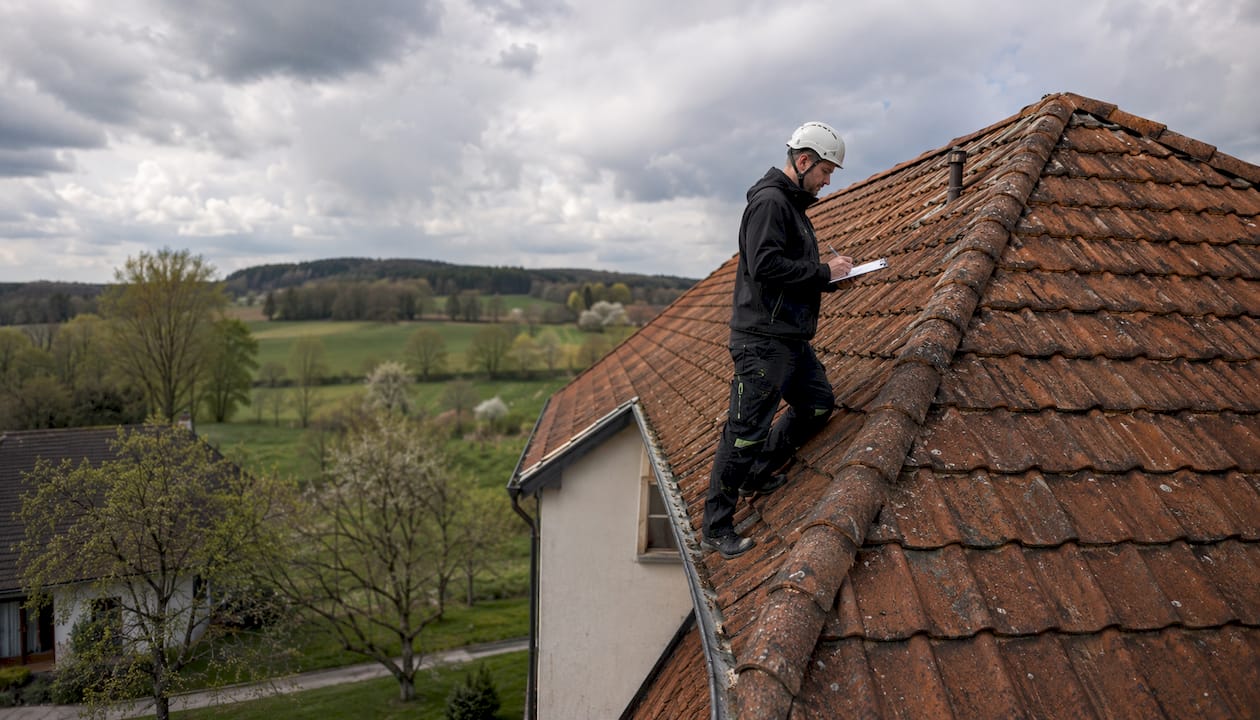
Roof shape and slope often drive costs more than the material itself. A hipped roof has more valleys, hips and junctions than a simple pitched roof. Every dormer adds connection work and scaffolding requirements. Steep roofs over 45° require safety systems and considerably extend working time. Mansard roofs combine several of these factors and can easily cost 20–30 % more than a comparable pitched roof.
Professional tip: Slate or clay tiles appear expensive. But converting lifespan into annual costs often makes them cheaper than concrete tiles that need replacing after 40 years. Long-term planning should compare total lifecycle costs rather than just the quoted price.
Which insulation method suits your roof, and what does it cost?
Three methods dominate practice. They differ in effort, achievable thermal performance and the right time to use them.
| Method | Cost/m² | Achievable U-value | Thermal bridges | When worthwhile? |
|---|---|---|---|---|
| Between-rafter insulation | 50–120 €/m² | 0,24 W/(m²K) | Rafters remain thermal bridges | Roof in good condition, no need for re-roofing |
| Above-rafter insulation | 150–250 €/m² (including re-roofing) | 0,14 W/(m²K) | Completely avoided | Re-roofing already planned |
| Below-rafter insulation | 30–60 €/m² | 0,24 W/(m²K) | Rafters remain thermal bridges | Internal fit-out, listed building protection, no external access |

TheAbove-rafter insulation(also known as over-roof insulation) is the technically superior solution: insulation boards are laid continuously over the rafters, thermal bridges are completely avoided and summer heat protection is considerably better than other methods. The disadvantage is the higher cost, but this becomes less significant if the roof needs re-covering anyway.
TheBetween-rafter insulationis the cheapest option and works well when the covering is still sound. However, usable rafter depth is limited and the rafters themselves remain thermal weak points. For BAFA funding, the post-insulation U-value must fall below a specified limit, which can be difficult with shallow rafters without supplementary below-rafter insulation.
TheBelow-rafter insulationis the only option when external access is impossible, for example due to listed building protection or an intact covering. It slightly reduces living space and cannot achieve very low U-values on its own. It is frequently combined with between-rafter insulation.
- For BAFA funding, a post-insulation U-value of 0,24 W/(m²K) or better is a guide value.
- For listed buildings, above-rafter insulation is often ineligible for permission; internal insulation is then the only option.
- Older buildings with shallow rafters (under 14 cm) almost always need a combination of between- and below-rafter insulation to achieve funding-eligible U-values.
Professional tip: Have the rafter cross-section measured before deciding. Many older buildings have rafters only 10–12 cm deep. Between-rafter insulation alone is then often insufficient for funding requirements, and the extra cost of above-rafter insulation pays off sooner than expected.
Which additional roof renovation costs are often underestimated?
Many estimates cover only the core work. What follows as variations regularly surprises homeowners.
- Roof windows (e.g. Velux, Roto):800–2.500 € per window including installation and junction work; cheaper during re-roofing because the roof is already open
- Dormers:8.000–25.000 € depending on size and construction; require structural checks and possibly planning permission
- Chimney junction:500–2.000 € for new flashings, valleys and waterproofing; old chimneys often also need renovation
- Lightning protection system:1.500–5.000 € for a new system or adaptation after roofing; mandatory in some German states
- Disposal of old materials:500–2.000 € for standard roof tiles; considerably more for hazardous waste
- Asbestos disposal:Can increase total costs by several thousand euros; mandatory for corrugated asbestos cement sheets or asbestos-containing roofing felt from before 1993
Take care with buildings from the 1960s to 1980s:Asbestos-containing materials were widespread during this period. Anyone renovating a roof of this age should commission a hazardous substance survey before starting. This costs 300–800 € but can prevent expensive surprises during construction.
Structural strengthening is another underestimated item. If clay tiles are to be installed on a roof previously covered with lighter concrete tiles, a structural engineer must check whether the rafters can bear the extra weight. The same applies if above-rafter insulation with an additional snow-load allowance is planned. Such reports cost 500–1.500 €, but are essential in cases of damage from structural failure.
Professional tip: Always allow a contingency of 10–15 % above the quoted price. For older buildings built before 1980 especially, this is practical experience rather than merely a precaution.
What funding is available for roof renovation in Germany?
Three funding routes are relevant to homeowners in Germany. They differ in requirements, amounts and application processes.
BAFA grant (Federal Funding for Efficient Buildings, BEG EM)
The BAFA grant is the most direct route to funding for roof insulation. A basic grant of 15 % of eligible costs rises to 20 % with an individual renovation roadmap (iSFP). The 5 % iSFP bonus is particularly worthwhile for larger projects.
Important conditions:
- The application must be submittedbeforeappointing the contractor
- An approved energy efficiency expert must oversee and confirm the measure
- The post-insulation U-value must fall below the required value (guide: 0,14 W/(m²K) for roof surfaces under the BEG standard)
- Maximum eligible costs are capped; the grant is calculated on that amount
KfW loan programmes (e.g. programme 261)
KfW programme 261 offers low-interest loans for energy efficiency renovations, combinable with a repayment subsidy. Renovating to an Efficiency House standard attracts higher repayment subsidies. For individual measures such as roof insulation, the BEG EM programme (BAFA grant) is generally more attractive because no loan is required.
Tax relief under § 35c EStG
Anyone not applying for BAFA funding can alternatively deduct 20 % of renovation costs from income tax over three years. The relief is spread across three years: 7 % in the first and second years, 6 % in the third. The building must be over ten years old and owner-occupied. The BAFA grant and § 35c EStG cannot be combined.
| Funding route | Amount | Requirement | Application |
|---|---|---|---|
| BAFA grant (BEG EM) | 15 % (20 % with iSFP) | Energy efficiency expert, proof of U-value | Before contract award |
| KfW 261 (loan + repayment subsidy) | Interest advantage + up to 20 % repayment subsidy | Efficiency House standard or individual measure | Before contract award |
| § 35c EStG (tax bonus) | 20 % over 3 years | Owner-occupied building, age > 10 years | Tax return |
Professional tip: Funding programmes depend on budgets and may be amended or stopped at short notice. Apply as early as possible and appoint the energy efficiency expert before obtaining quotes. This avoids inadvertently starting the project before applying and losing funding.
When does roof renovation trigger GEG obligations?
The Building Energy Act (GEG) does not apply to every repair. But renewing more than 10 % of a component's area requires compliance with that component's minimum energy performance requirements.
- Trigger:Renewing more than 10 % of the roof area (covering, insulation or both) counts as a substantial alteration under GEG.
- Required value:For roof surfaces, a post-renovation U-value of 0,24 W/(m²K) is a guide; the exact value depends on the component and construction.
- Evidence:The contractor or an energy adviser must document compliance. Fines may apply without evidence.
- Listed building exception:Reduced requirements apply to listed buildings if the measure is technically or economically unreasonable. The relevant conservation authority decides case by case.
State-specific requirements apply too. In some German states, a solar obligation has applied to complete roof renovation since 2026, for example Baden-Württemberg and North Rhine-Westphalia. Anyone completely re-roofing there must check whether a photovoltaic system is mandatory. This triggers additional investment, but can also be combined with KfW photovoltaic programmes.
Professional tip: Before planning begins, clarify with your roofer and, if needed, an energy adviser whether your project counts as a substantial alteration under GEG. An early check prevents costly remedial work that is hardly economical once the project is complete.
How do you obtain reliable quotes, and what should you look for?
A quote is only as good as its underlying specification. Many homeowners compare final prices without checking whether the work is actually comparable.
Checklist: what every quote must contain
- Exact roof area in m² (broken down by covering, insulation and special areas)
- Material designation with manufacturer, type and quality grade (no “tiles of choice”)
- Insulation thickness and U-value after installation
- Scaffolding costs as a separate item (not hidden in the overall lump sum)
- Disposal costs for old materials, hazardous waste disposal separately shown where relevant
- Defects liability period (statutory 5 years for the work)
- Schedule with start, duration and milestones
- Payment schedule (no full advance payment)
Questions to ask every contractor:
- Are subcontractors planned, and if so, for which trades?
- Who is the responsible site manager?
- How will disposal of old materials be documented?
- Is current public liability insurance in place?
- Is the business registered as a master craftsman roofing firm?
Warning signs in quotes:
- Lump-sum items without quantities (e.g. “roofing lump sum 15.000 €”)
- No separate scaffolding item
- Payment term: more than 30 % in advance before construction starts
- Missing information on material origin or quality
- Quote without defects liability provisions
Whencomparing contractors' quotes, a simple assessment framework helps: price per m² combined with material class and workmanship standard. A quote at 90 €/m² for concrete tiles and one at 110 €/m² for clay tiles are not directly comparable. Only when you put the services on a common basis does the price difference become meaningful.
How do you use a cost calculator to establish a realistic guide price?
A cost calculator does not provide a binding figure, but a reliable starting point for discussions with contractors. It needs the right inputs to produce the right result.
What a good cost calculator should ask:
- Roof area in m² (house footprint multiplied by roof pitch factor, not the floor plan)
- Roof shape (pitched, hipped, mono-pitch, mansard, flat)
- Planned scope (repair, re-roofing, insulation, complete refurbishment)
- Material class (concrete tile, clay tile, slate, metal)
- Insulation method and desired thickness
- Region (postcode or German state, as labour costs vary regionally)
How to calculate a guide price yourself:
- Determine roof area: house footprint (e.g. 10 m × 12 m = 120 m²) multiplied by pitch factor (approx. 1,22 at 35°) gives around 146 m² of roof area.
- Choose a cost rate: for re-roofing with between-rafter insulation (clay tiles, medium quality), a realistic 150–300 €/m².
- Calculate total costs: 146 m² × 200 €/m² = 29.200 € as the midpoint.
- Add contingency: 10–15 % for unforeseen items, or 2.920–4.380 €.
- Deduct funding: a BAFA grant of 15 % on eligible costs (e.g. insulation portion only) produces a further reduction.
TheCleverbauen24 renovation cost calculatoruses regional market data and gives you a differentiated range according to scope and material class. The result is not a quoted price, but a benchmark for assessing incoming quotes.
Reducing costs strategically: practical recommendations from Cleverbauen24
The greatest potential savings lie in the project structure rather than negotiating the final price.
Professional tip: Combine re-roofing, insulation and, where worthwhile, photovoltaics in one contract. Scaffolding and logistics costs are then shared once across all measures. The relative additional costs for insulation and PV are considerably lower than for separate interventions.
Typical indicators of hidden work that Cleverbauen24 regularly identifies in quote reviews:
- Roof structure condition:Missing information on rafter checks or structural assessments is a warning sign. A reputable business states what it has and has not checked.
- Suspected asbestos:Buildings from the 1960s to 1980s without a hazardous substance report carry a substantial variation risk.
- Moisture damage:Dark patches on rafters or purlins in loft photos suggest moisture that must be addressed before covering.
Cleverbauen24's AI-assisted quote review analyses incoming quotes for missing items, unclear specifications and deviations from regional market prices. Typical findings include missing scaffolding items, unspecified materials and payment terms transferring insolvency risk to the client. Anyone wanting tohave a quote reviewedtherefore receives a reliable negotiating basis.
Key findings
For a typical detached house with 150 m² of roof area, roof renovation costs between 12.000 and 75.000 € depending on scope, with combined re-roofing and insulation offering the best value for money.
| Topic | Details |
|---|---|
| Cost range by scope | Re-roofing 80–160 €/m², with insulation 150–300 €/m², complete refurbishment 250–500 €/m² |
| Do not miss funding | BAFA grant of 15 % (20 % with iSFP) must be applied for before awarding the contract |
| Make use of unavoidable costs | Sharing one set of scaffolding and logistics costs between re-roofing and insulation saves considerably |
| Check GEG obligations | Renewing more than 10 % of the roof area triggers minimum energy performance requirements |
| Use Cleverbauen24 | A free Quickcheck and AI-assisted quote review from 79 € help avoid expensive mistakes |
Why these recommendations? Some context
The recommendations in this guide are based on a pattern repeatedly observed while supporting over 150 renovation projects: the most expensive mistakes arise from incomplete quotes, missed funding applications and absent risk checks before construction, rather than poor contractors.
If a roof renovation quote lists no scaffolding, specifies no materials and demands 50 % in advance, you have a risk rather than a quote. Cleverbauen24's AI-assisted review reliably identifies precisely these patterns before a contract is signed. Customer satisfaction of 4,8 out of 5 across more than 150 supported projects demonstrates the difference structured preparation and independent review can make.
My advice: treat funding checks and quote reviews as integral parts of the project rather than optional steps. Both take little time and can save several thousand euros.
How Cleverbauen24 helps with your roof renovation
Anyone planning a roof renovation faces three specific problems: not knowing whether the quote is fair, whether all funding is being used or whether the contractor will deliver what they promise. This is precisely where Cleverbauen24 helps.

Thefree Quickcheckprovides an initial assessment within minutes of whether your quote fits regional market rates. Thepaid review report from 79 €goes deeper: it analyses every item for completeness, price plausibility and typical risks such as missing defects liability provisions or unclear material details. Typical findings from real reports are available on theCleverbauen24 quote review page. Cleverbauen24 also introduces vetted trade businesses and provides the renovation cost calculator free of charge.
Start with the free Quickcheck now or order afull review reportdirectly before you sign.
Further trustworthy sources
Official bodies and independent guides are the most reliable sources for planning roof renovation. Information current as of 2026. Check funding pages immediately before applying, as terms may change at short notice.
- KfW funding programmes:Overview of all loan and grant options for energy efficiency renovations, including programme 261 and BEG individual measures. First port of call for loan enquiries and repayment subsidies.
- BAFA Federal Funding for Efficient Buildings (BEG):The authority responsible for grant applications for individual measures such as roof insulation. Apply here before awarding a contract.
- Building Energy Act (GEG) at gesetze-im-internet.de:Full GEG text with all current requirements and exceptions. Relevant when checking whether your project triggers a retrofitting obligation.
- Finanztip: roof insulation and roof renovation:Independent consumer guide covering funding requirements, cost-effectiveness assessments and typical cost traps.
- Cleverbauen24 renovation cost calculator:For an initial estimate using regional market data before obtaining quotes.
Recommended order of use:Start with the BAFA portal to check funding requirements and current rates. Then use the full GEG text or an energy adviser to clarify whether your project triggers retrofitting obligations. Use the renovation cost calculator alongside quote preparation to establish a realistic cost range before the first roofer inspects the roof.
Note: this guide provides general information and does not replace individual advice from an energy efficiency expert, tax adviser or specialist solicitor. Funding terms and legal requirements may change. Check current conditions with the responsible bodies before applying.
Recommendation
- What does renovation cost in 2026? Cost overview by trade | cleverbauen24
- External wall insulation costs 2026: ETICS, prices and funding | cleverbauen24
- Kitchen renovation costs 2026 – what property owners should budget for | cleverbauen24
- Bathroom refurbishment costs 2026: how much does a new bathroom cost? | cleverbauen24
This article was created with AI assistance and reviewed by the editorial team.
Comments
No comments yet — be the first to contribute.